


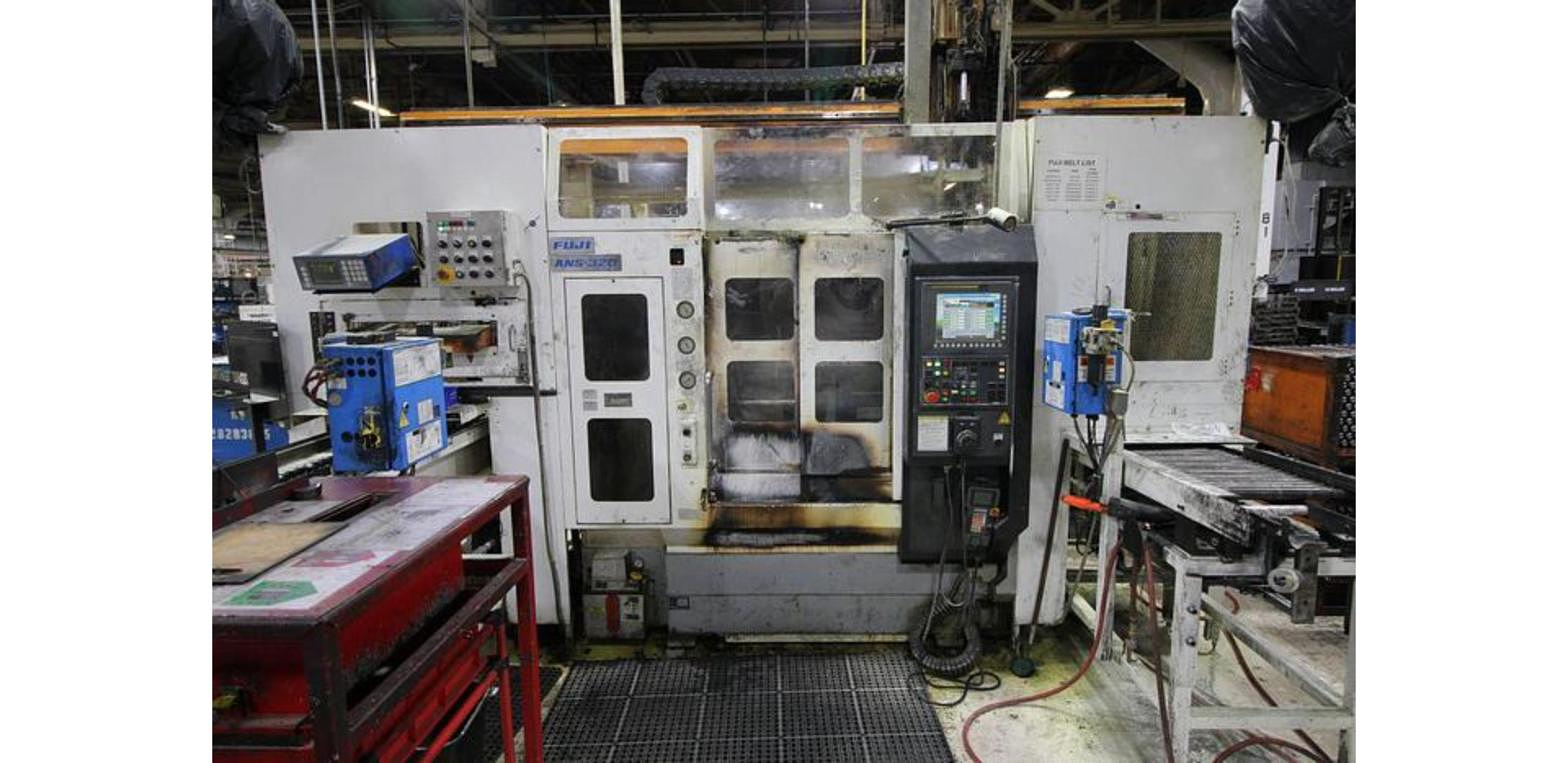
A used CNC lathe comes down to the spindle, the chuck, the turret and the control. Check spindle runout and bearing noise, the chuck and its hydraulics, turret indexing and clamping, and backlash in the slides. Then match the machine to your parts: chuck size, bar capacity, and whether a horizontal or vertical layout suits the work.
Horizontal or Vertical
Most CNC lathes are horizontal. The spindle points sideways, bar stock can feed through the back, and shafts can be supported by a tailstock. That layout fits bar work and long parts. Our used CNC machines and machine shop liquidations both carry Fuji lathes right now.
A vertical lathe stands the spindle up on end. Gravity holds a heavy, short part down against the chuck, chips fall away from the work, and loading from above is easier for a crane, a loader or a parts transfer robot. Emag's VSC machines use an inverted spindle that picks up the part and carries it to the tools. If you turn short, heavy parts like gear blanks or hubs at volume, a vertical is worth a look. Gear blanks usually go on to gear cutting next, and we carry used gear machinery as well.
Spindle and Chuck
- Runout and noise. Indicate the spindle nose and the chuck face. Run the spindle through its speed range after a warm up and listen for bearing noise.
- Spindle drive. Spindle alarms can come from the drive and not the bearings. We keep a FANUC spindle amplifier listed by exact part number.
- Chuck condition. Look at the master jaw serrations, the T-nuts and the jaw ways for wear and cracks. Ask what jaws come with it.
- Hydraulics. Watch the chuck pressure gauge while it clamps and unclamps. Look for leaks at the cylinder and the rotary union, and listen to the hydraulic unit.
- Spindle bore. If you run bar, confirm the bore and draw tube pass the bar size you need.
Turret and Tooling
Index the turret to every station and watch for hesitation, clunking or a turret that does not lock up the same every time. Check the clamp with an indicator on a tool. Make sure coolant comes out at each station. Find out whether the tool holders and boring bar sleeves come with the machine, because lathe tooling adds up fast. Do not assume live tooling or a sub spindle. Confirm them on the machine.
Most of our used tool holders are milling holders, CAT and HSK, so plan lathe tooling separately. Our Valenite boring bars, for example, are CAT 50 tooling for machining centers, not turrets.
Slides, Tailstock and Axes
Check X and Z for backlash with an indicator, moving a small amount and reversing. Look under the way covers for chips and scoring. Make sure the way lube system is pumping. Run the tailstock out and check the quill for play, then check that it lines up with the spindle.
If you turn shafts between centers, good center holes matter as much as the tailstock. A center hole grinder grinds those holes, often after heat treat, so the part runs true for finishing. Our full used grinders list has the other finishing machines.
The Control
FANUC is one of the most common lathe controls you will run into. One of the lathes in our liquidation stock, the TNW 3500 TR, runs a FANUC 310i control. On any control, look for standing alarms, check the alarm history, and ask for a backup of the parameters and ladder. Write down the options. If you need control hardware, we have FANUC CNC parts like a FANUC Series 160i and a FANUC 18i. Any drive part has to match the number on your machine exactly, which is why our FANUC servo amplifiers are listed by exact part number.
Loading, Bar Feed and Automation
If you plan to run bar, check the bar feeder interface and whether the machine has a part catcher. If you plan to load with a robot, look at the door, the chuck signals and the space in front of the machine. Our post on machine tending robots covers how those cells go together. Small parts suit a FANUC LR Mate 200iD/7L, and heavier parts suit something like a FANUC M-20iA/35M.
Conveyors and washers round out a turning cell. We have Zeta Group automation conveyors and a Walmil parts washer in liquidation stock.
Coolant and Chips
Run the coolant pump and look at the tank. Check that the chip conveyor runs both ways. Stringy chips from steel jobs wrap around everything, so a high pressure coolant system like our ChipBlaster J30 can help break them up.
Lathes in Stock
Stock changes fast, especially in liquidations. Check the pages for current machines.
- Used CNC lathes: Fuji ANS320, ANS3400 (2014) and ANS-320TTS (2008), plus a TNW 3500 TR with FANUC 310i control (2008)
- Emag VSC130 vertical lathe: 1996
- Fuji HM-30T1 lathe: 2003, listed with a Sunnen hone
To spread out the cost, see our machinery financing page. Machines ship FOB Imlay City, Michigan, and the buyer arranges freight.
Related Guides
- Used CNC machine inspection checklist
- Used vertical machining center checklist
- Boring heads and boring bars explained
Got a Lathe to Sell?
We buy used CNC lathes and whole shops. Use our sell your used CNC machines page, or ask about appraisal services for a single machine or a full plant.
To ask about any of these lathes, call 586-752-0090, extension 1 for sales, or contact RAB sales.