


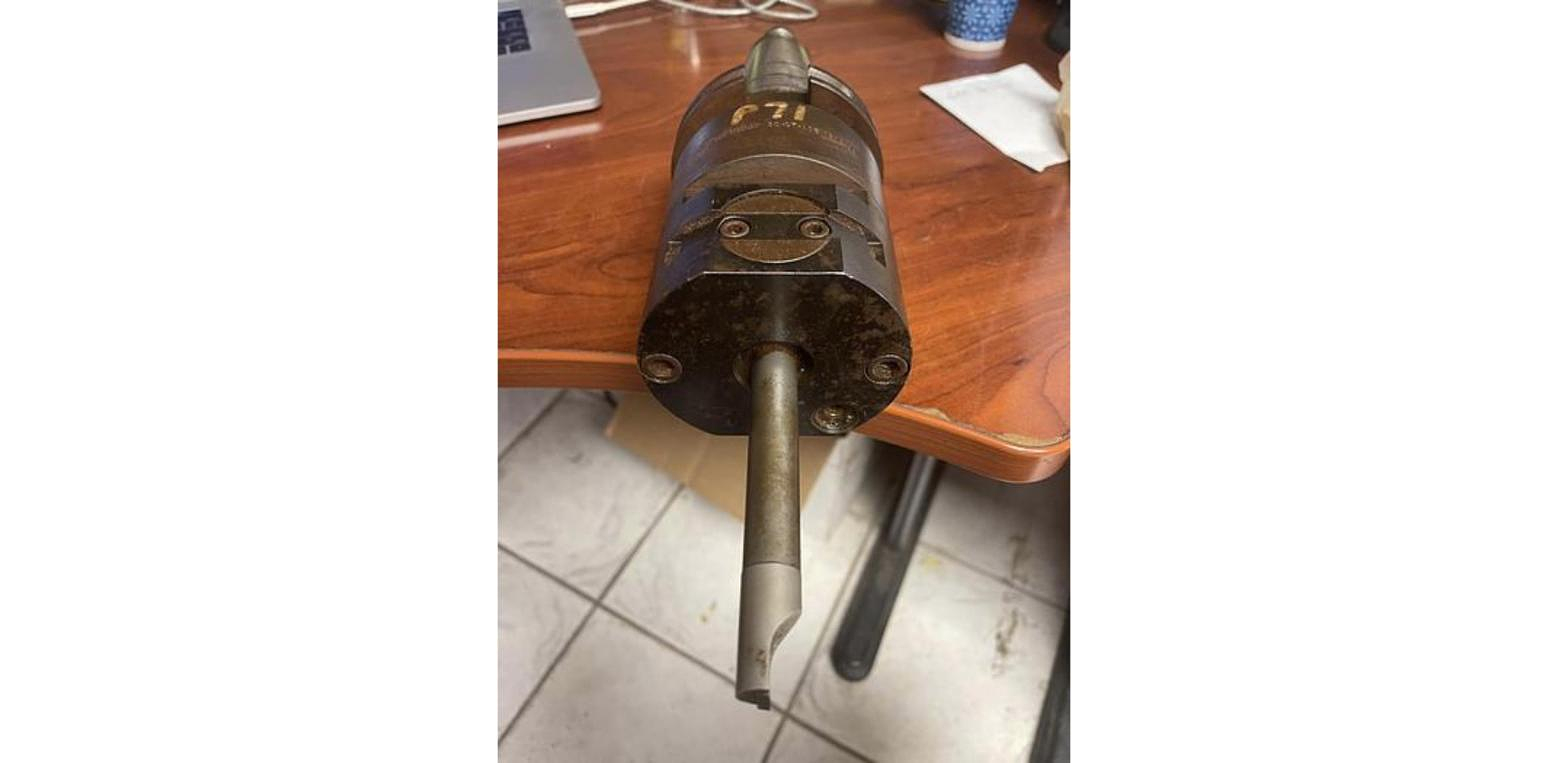
A boring head is an adjustable holder that offsets the cutter so one tool can finish a range of hole sizes, set by a dial in fine steps. A boring bar is the long tool that carries the cutting edge into the hole. Its diameter, length and material decide how deep you can bore before it chatters.
What Boring Does
Boring opens up a hole that is already there, whether it was drilled, cast or roughed out. It brings the hole to size, makes it round and straight, and puts it where the print says. A drill follows its own path. A single point boring tool cuts the hole where the spindle puts it. Many bored holes start with a drill, and an indexable drill like our Walter unit is a quick way to get the pilot hole in.
How a Boring Head Works
The head mounts in the spindle like any other holder. A slide across the face carries the boring bar or cutter, and a graduated dial moves the slide a set amount per mark. Turn the dial, lock the slide, take a cut, measure, and adjust. Fine adjust heads let you sneak up on a tight tolerance without swapping tools.
We carry TSD Microbore boring heads and more TSD boring heads on a second listing. On a used head, check that the dial turns smoothly, the slide has no play when locked, the lock screw holds, and the shank taper is clean and undamaged.
Rough Boring and Finish Boring
Roughing and finishing are often two different tools. A roughing tool takes the heavy stock out fast. A finish boring head takes a light final pass and sets the size. Splitting the work keeps the finish tool sharp and the size steady through a run. On a modular system, both tools can share the same shank and extensions. We have modular tool holders from Mapal and Komet and a Sandvik Varilock extension in stock.
Choosing a Boring Bar
- Diameter. Use the largest bar that fits the hole with room for chips. A bigger bar is a stiffer bar.
- Overhang. Keep the bar as short as the job allows. Chatter gets worse quickly as the bar sticks out farther.
- Material. Carbide bars are stiffer than steel and can reach deeper before chatter starts. Damped bars are made for the longest reaches.
- Taper. Match the shank to your spindle. Our Valenite CAT 50 boring bars are V50CT bars for 50 taper machines, and our CAT 50 tool holders fit the same spindles.
- Insert. A sharp, positive insert with a small nose radius cuts with less force and is less likely to chatter.
- Coolant. Through coolant flushes chips out of deep blind holes. A high pressure coolant system like the ChipBlaster J30 helps here.
Machines That Bore
Any machining center can bore with the right head. Our used vertical machining centers include a Samsung MCV 50 with a FANUC 0i control, and the rest of our used CNC machines are listed on the CNC category. On a lathe the bar sits in the turret and the part turns instead. Our used CNC lathes include several Fuji models, and the Emag VSC130 vertical lathe is there for vertical turning.
For holes that need more than boring can give, other processes take over. A Sunnen hone sizes and finishes a bore, and an internal grinder such as the Bryant Lectraline LL2U finishes hardened bores. For big parts that only need holes drilled, a radial drill like our Invema FR40-1500 reaches across a big part without moving it. See all of our used grinders as well.
Boring Tooling We Carry
Stock moves fast in tooling. Check each listing for what is on hand.
- Kaiser tooling: check the listing for the exact pieces on hand
- Valenite CAT 50 collet holders: for the drills and reamers that go with a boring job
- face mill holders: Parlec C50 and Sandvik, for facing the part before you bore
- tooling and tool holders: our full tooling category
Related Guides
Have Tooling to Sell?
Boring heads and bars often sit in a crib long after the machine is gone. We buy tooling with or without the machines. Start on our sell your used tooling page, or ask about appraisal services for a full shop.
For questions on a boring head or bar, call 586-752-0090, extension 1 for sales, or contact RAB sales.