


A collaborative robot is built to limit force and stop on contact, so some jobs can run next to people with less fixed guarding after a proper risk assessment. A traditional industrial robot is faster and stronger and normally works behind guarding. The right choice depends on payload, cycle time, and how close people need to be.
What Makes a Robot Collaborative
A cobot watches for unexpected contact and limits how hard it can push. When it bumps into something it should not, it stops. That lets it share space with an operator on the right job. Many cobots can also be moved by hand to teach points, which makes setup quicker for people who are not robot programmers.
Here is the part that gets missed. The application is what is collaborative, not just the robot. A cobot swinging a sharp part, a hot part or a knife can still hurt someone. Every cobot cell needs a risk assessment, and the industrial robot safety standard, ISO 10218, is where that work starts. Some cobot cells still end up with guarding or a safety light curtain once the risk assessment is done.
FANUC CR Series Cobots
FANUC's CR series robots are collaborative. Our data sheets show how they size up:
- FANUC CR-4iA: 4 kg payload, 550 mm reach.
- FANUC CR-7iA: 7 kg payload, 717 mm reach.
- FANUC CR-7iA/L: 7 kg payload, 911 mm reach.
- FANUC CR-35iA: 35 kg payload, 1,813 mm reach, about 990 kg of robot.
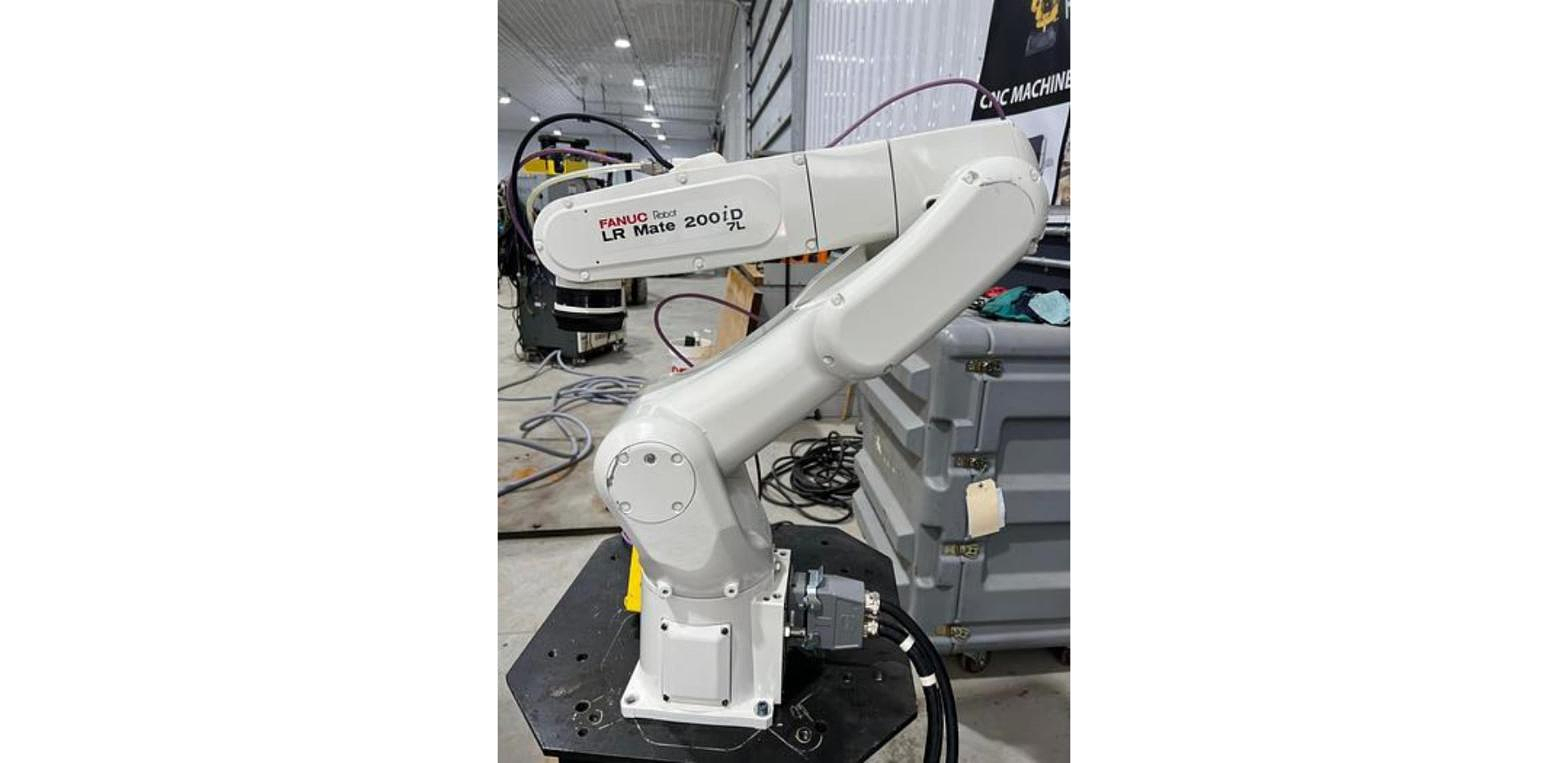
Look at those numbers next to FANUC's standard arms. The FANUC LR Mate 200iD is also a 7 kg robot with 717 mm of reach, and the LR Mate 200iD/7L matches the CR-7iA/L at 7 kg and 911 mm. The FANUC M-20iA/35M carries 35 kg at 1,813 mm, the same as the CR-35iA. Same payload, same reach. The difference is how they are allowed to work around people, and how fast they run when they do.
The Universal Robots UR10
The UR10 is one of the best known cobots on the used market. It is a 10 kg class arm built for collaborative operation, again after a risk assessment, and it is a common pick for machine tending robots next to a CNC and for light end of line packing. We have UR10 units from 2017 and 2018. See them in our robots from other brands category.
Where a Traditional Robot Wins
- Cycle time. A cobot working near people runs slower. If the job is about parts per hour, a standard arm behind guarding will usually beat it.
- Payload. Cobots top out well below the heavy industrial arms. For castings, engine parts and pallet loads, you are into material handling robots like our used FANUC robots and the heavy arms in our used KUKA robots stock.
- Hazardous processes. Welding, cutting and high force jobs usually end up guarded, whichever robot does them.
- Precision force work. A standard FANUC arm fitted with a force sensor, like the FANUC FS-40iA force sensor we carry, can handle tight fit robotic assembly inside a guarded cell.
Where a Cobot Makes Sense
Cobots earn their place on low to medium volume jobs with light parts, where an operator works close by: kitting, light robotic dispensing, inspection with robotic vision, and loading a machine where there is no room for a full guarded cell. They also make sense when floor space is tight or the cell moves between jobs. Plan your end of arm tooling with the risk assessment in mind, since the gripper is often the biggest hazard in the cell.
Cobots and Standard Arms in Stock
Stock changes often. Click through for the current listing.
- Universal Robots UR10: 10 kg class collaborative arm, 2017
- Universal Robots UR10: 10 kg class collaborative arm, 2018
- FANUC LR Mate 200iD/7L: 7 kg payload, 911 mm reach
- FANUC LR Mate 200iD/7L, never used: 7 kg payload, 911 mm reach
- FANUC LR Mate 200iD: 7 kg payload, 717 mm reach
- FANUC M-10iA/12S: 12 kg payload, 1,098 mm reach
- FANUC M-20iA/35M: 35 kg payload, 1,813 mm reach
Related Guides
Have Cobots or Robots to Sell?
We buy collaborative and standard robots, one at a time or by the plant. Use our sell your used robots page, or set up an equipment appraisal.
Talk to us about which arm fits your job at 586-752-0090, extension 1 for sales, or contact RAB sales.