


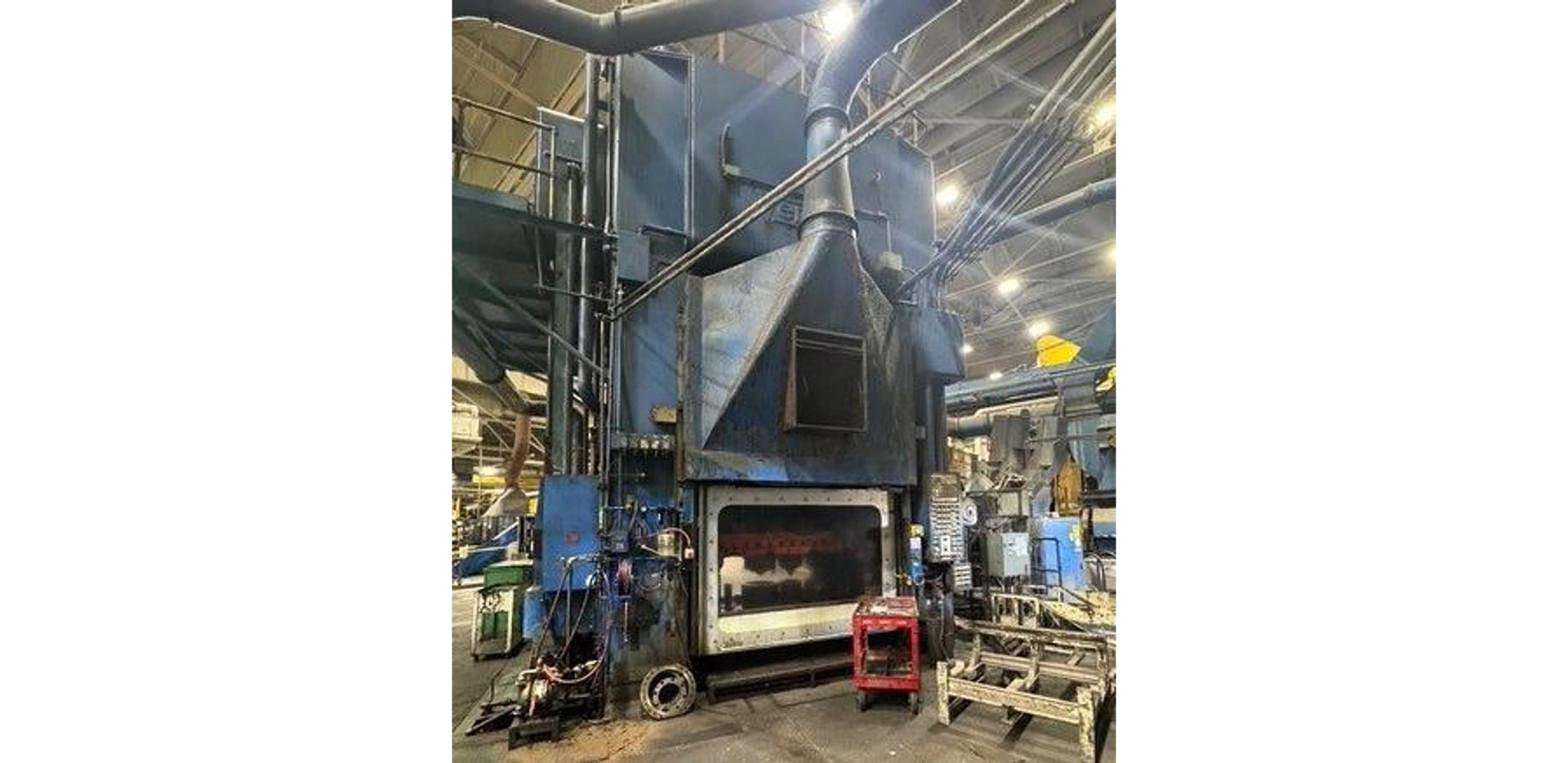
Before you buy a used stamping press, check the frame for cracks, the clutch and brake for wear and stopping time, the crown for gear and bearing wear, and the slide for gib clearance and working adjustment. Then look at the controls and guarding, confirm the die space fits your dies, and plan how coil or blanks will feed it.
Frame and Bed
Start with the iron. Look for cracks at the corners of the crown, around the bed, and in the throat of a gap frame. Weld repairs are not automatically a deal breaker, but you want to know where they are and why they were made. On a straight side, check the tie rod nuts and look for signs the frame has shifted. Presses that come out of a plant liquidation are often pulled straight from production, so ask how the press was running and what it was making before it came out.
Check the bolster plate for flatness, cracked T-slots and old die damage. A bolster that has been re-machined may have lost thickness, which changes your shut height.
Clutch and Brake
Many mechanical presses in the used market have an air operated friction clutch and brake. Look at the friction material, listen for air leaks, and find out if the press has a brake monitor. Stopping time matters for more than wear. It sets how far a light curtain has to sit from the point of operation, so a slow brake can mean moving the guarding back.
On presses like that, the clutch, brake and slide counterbalance usually run on shop air. Make sure your industrial air compressors can supply the press at the pressure it needs, and keep water out of the lines with a refrigerated air dryer. Wet air is hard on valves and clutch parts.
Crown and Drive
On a top drive press, the crown holds the flywheel, gears and crankshaft, with the connections running down to the slide. Look for oil leaks, chipped or worn gear teeth, and play in the connections. Ask how the lube system works and whether it has been kept up, since a dry bearing in the crown is an expensive repair. Look at the main motor and drive belts while you are up there.
Slide, Gibs and Adjustment
- Gib clearance. Loose gibs let the slide rock, which shows up as uneven die wear. Check clearance on all corners.
- Parallelism. The slide face should sit parallel to the bolster across the full width.
- Slide adjustment. Run the adjustment through its range and confirm the shut height indicator reads right.
- Counterbalance. The counterbalance has to carry the slide plus your heaviest upper die. Find out what range it is set up for.
- Overload protection. If the press has hydraulic overload protection, find out whether it works and how it resets.
Controls and Guarding
An old relay control can run fine for years, but plan on updating guarding and controls to current safety rules where needed. Look for two hand controls, a brake monitor, light curtains and a tonnage monitor if you run tight dies. If you plan to automate, check how the control will talk to a robot or feed. Our write up on industrial robot I/O covers the signals involved.
Die Space
Write down your largest die and compare it to the press: shut height, stroke, bolster size, slide area and window openings. A mechanical press only delivers its rated tonnage near the bottom of the stroke, so check where on the stroke your work happens. Deep draws and long forming strokes need more press than the tonnage number suggests. Browse our used stamping presses with your die list in hand.
The Feed Line
A coil fed press needs a decoiler, a straightener and a feed sized to your coil width, thickness and weight. Look at our press room equipment for what is available now. Blank fed and transfer jobs often use robots instead, covered in our posts on press tending robots and parts transfer robots.
Press to press transfer of heavy panels calls for a large arm, such as the FANUC R-2000 robots. Smaller parts fit an arm like the FANUC M-710iC/50. A robot on robot transfer units can serve more than one press. The grippers matter as much as the arm, so read up on end of arm tooling and robotic quick change tooling for die changeovers.
Freight and Setup
A big press is a rigging job. Plan the foundation or pit, the electrical service and the air supply before it ships. Everything we sell ships FOB Imlay City, Michigan, and the buyer arranges freight and rigging. If the purchase is large, look at our equipment financing options.
Press Room Stock
Stock changes. Check each listing for the model code and year as shown.
- Verson straight side double crank presses: listed models include T-SE2-1500-96-54 (1977 and 1980), S2-500-108-60 (1970) and TS2-500-156-42T (1968), plus a USI Clearing S4-300-144-72 (1972)
- Perfecto 38-18-5 decoiler: 1976
- Cincinnati CBII 90-350 hydraulic press brake: 1998
- FANUC M-900iA/350: 350 kg payload, 2,650 mm reach, for heavy panel handling
- FANUC M-410iB/450: 450 kg payload, 3,130 mm reach, for stacking finished parts
Related Guides
Selling Press Room Equipment?
We buy presses, feed lines and the robots that serve them, up to a full plant. Start on our sell your press room equipment page, or ask about press appraisals.
To talk through a specific press, call 586-752-0090, extension 1 for sales, or contact our sales desk.