


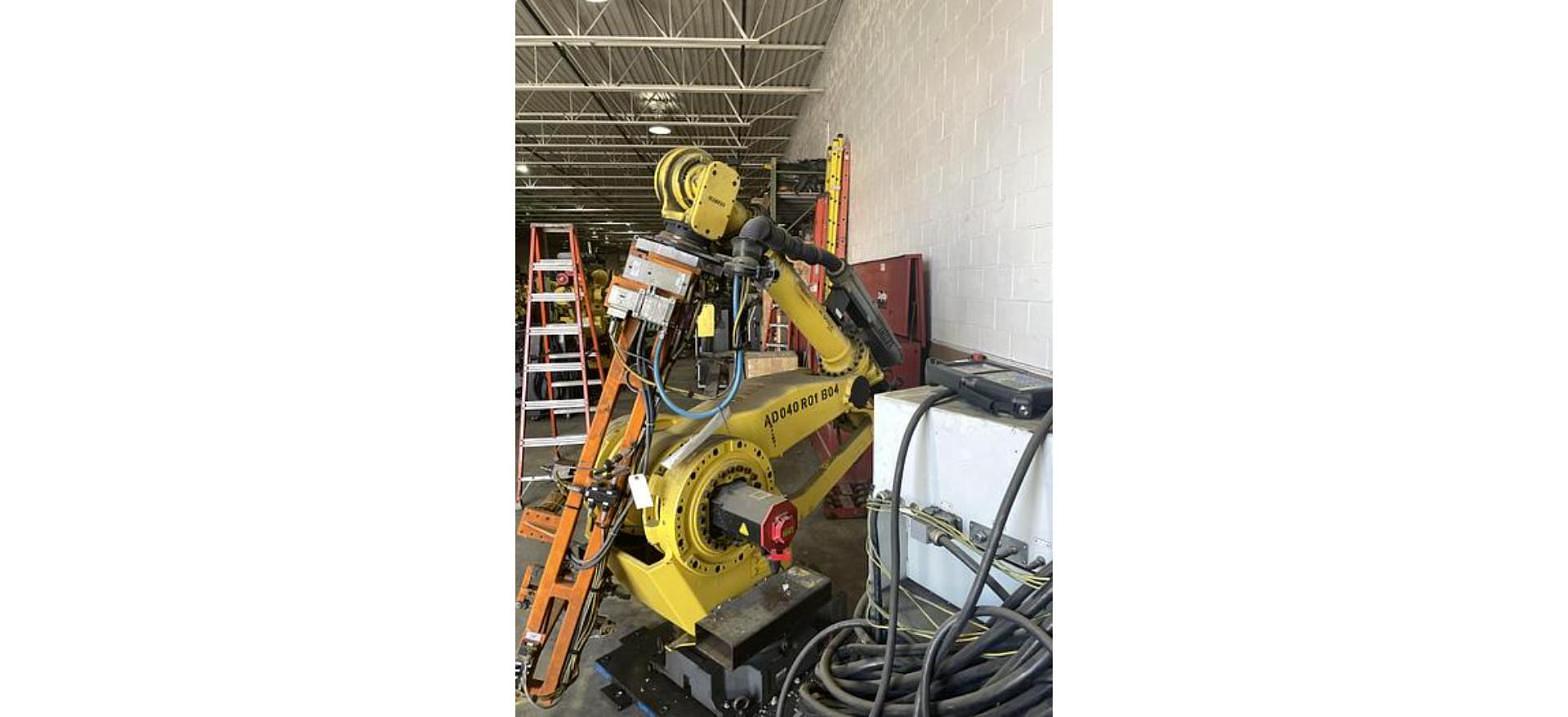
The right robot for deburring is stiff enough to hold a path under cutting load, repeatable enough to hit the same edge every cycle, and rated to carry the spindle or tool on its wrist with room to spare. Force sensing or a compliant tool handles part to part variation. Pick by tool weight and part size first.
Two Ways to Set Up a Deburring Cell
The robot holds the tool. A spindle, file or brush mounts to the wrist and the arm follows the edge of a part held in a fixture. This is the usual choice for large or heavy parts, castings and weldments that are hard to pick up. The tool weight sits on the robot all day, so it sets the payload.
The robot holds the part. The arm picks the part and presents it to a fixed spindle, belt sander or brush. This works well for small and mid size parts, and it lets one robot load, finish and unload in one cycle, much like machine tending robots. Here the payload is the part plus the gripper.
Either way, deburring is one branch of robotic material removal, alongside grinding and polishing. If you are finishing stone or similar material, see our post on robotic stone cutting and polishing.
Stiffness
A deburring tool pushes back on the robot. An arm that is working near its rated payload will deflect more under that load than one running well inside it. That is why finishing cells often use a robot one size bigger than the tool weight alone would suggest. A mid size arm like the FANUC M-20iB/25 carrying a light spindle has plenty of margin. For heavy castings, a large arm like the FANUC M-900iA/350 can hold the part against a fixed grinder. Our FANUC M-900 series guide covers that class.
Repeatability
Repeatability is how closely the robot returns to a taught point. It is listed on the data sheet, and it matters for finishing because you are chasing an edge that may be a fraction of a millimeter wide. The LR Mate 200iD data sheet lists 0.02 mm, the M-20iB/25 data sheet lists 0.05 mm, and the M-900iA/350 data sheet lists 0.3 mm. Small parts with fine edges call for the tighter numbers.
Keep in mind that repeatability is measured without a cutting load. It tells you how well the robot returns to a point, not how the parts vary. Castings and weldments are never identical, which is where sensing comes in.
Tool Weight on the Wrist
A spindle hangs out past the faceplate, so its weight acts on the wrist like a lever arm. Check the allowable wrist load and inertia on the data sheet, not just the payload number. Add the spindle, the tool holder, any compliance unit and the air or power lines. Arms with a high inertia wrist, such as the FANUC M-20iA/35M, are worth a look when the tool sticks out a long way.
If the cell runs more than one tool, a tool changer keeps the robot working. Our post on robotic quick change tooling explains the setup, and our write up on end of arm tooling covers grippers and holders. Route air and power lines with care; see our notes on robot cable management.
Force Sensing and Compliance
A robot running a fixed path will cut too deep on a high part and miss the burr on a low one. There are two common fixes. A compliant spindle floats a little in the holder and keeps steady pressure on the edge. A force sensor between the wrist and the tool lets the robot feel the contact and adjust its path in real time. We have a FANUC FS40iA force sensor in stock. Confirm that the controller has the matching software option before you plan on force control.
Vision can also help the robot find the part before it starts. Our post on robotic vision applications covers how that works.
Dust and Grit
Finishing throws chips and fine dust. Protection ratings vary by model, so check the listing or data sheet, and plan on dust collection and a robot cover for heavy grinding.
Deburring Robots We Carry
- FANUC LR Mate 200iD: 7 kg payload, 717 mm reach, 0.02 mm repeatability
- Yaskawa Motoman HP6: small arm, NX100 controller
- Kawasaki RS020N: 20 kg class, E01 controller
- never used FANUC M-710iC/20L: 20 kg payload, 3,110 mm reach, for long-reach, light-tool work
- FANUC M-20iB/25: 25 kg payload, 1,853 mm reach, 0.05 mm repeatability
- FANUC M-20iA/35M: 35 kg payload, 1,813 mm reach, high inertia wrist for tools that stick out
- ABB IRB 2400/16: IRC5 control, listed as a MIG welding cell
- FANUC M-900iA/350: 350 kg payload, 2,650 mm reach, R-30iB
You can see every used FANUC arm on our used FANUC robots page, and servo motors and amplifiers on our robot parts and accessories page. For the ABB side, see our ABB IRB series guide.
Related Guides
Have Finishing Robots to Sell?
Finishing cells get replaced when the part changes. If yours is coming out, we will buy the robot alone or the whole cell. Start with our sell your machinery page, or ask about robot appraisal services.
Have a question on one of these arms? Call our sales line at 586-752-0090, extension 1, or contact our sales team.