


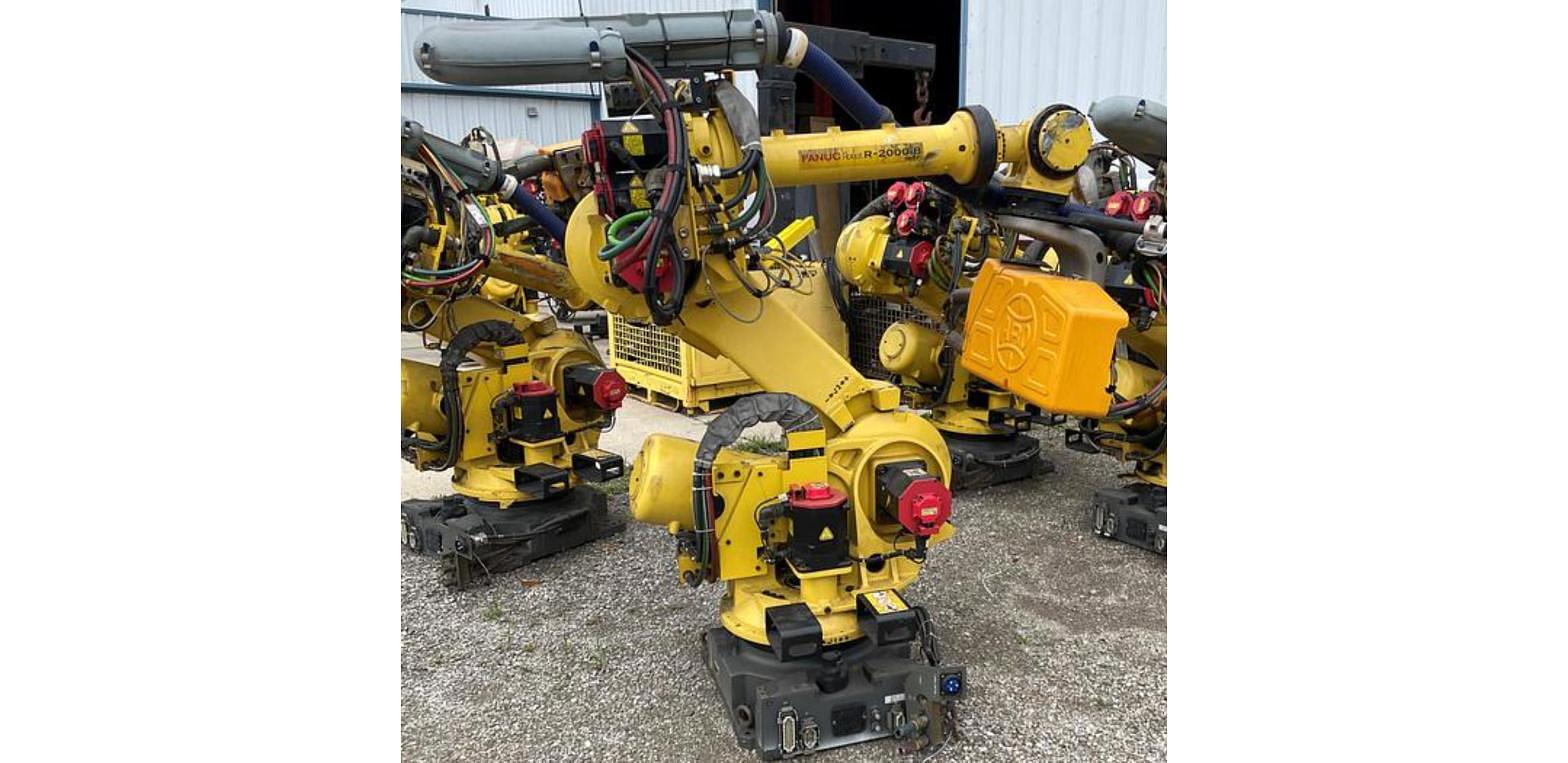
Foundry robots handle castings, support ladling, grind and deburr castings, and move parts between molding, shakeout and finishing. The work is heavy, hot and dirty. Foundry cells tend to run large arms, such as the FANUC R-2000 or M-710iC/50. Protection ratings and foundry packages vary by model, so confirm them on the listing or data sheet.
Foundry Jobs Robots Do
Casting handling. Pulling castings out of a die cast machine or off a mold line and carrying them to a quench, a trim press or a cooling conveyor. It is heavy material handling in a rough setting, and the trim press side works a lot like press tending.
Ladling support. In some die cast cells a robot carries the ladle from the holding furnace to the machine and pours. The arm works close to molten metal, so heat shielding and the build of the arm matter more here than anywhere else in the plant.
Grinding and deburring. Gates, risers and parting line flash all have to come off. A robot holding a grinder, or holding the casting against a fixed grinder, takes that work off people. Our post on robotic material removal covers the methods, and robotic quick change tooling lets one arm switch between a gripper and a grinding head.
Part transfer and cleaning. Moving castings between machining, inspection and packing is standard parts transfer work. Castings with sand or chips in them often go through robotic high pressure washing before they ship.
What Heat, Dust and Grit Do to a Robot
Sand, metal dust and grinding grit get into seals, wrist joints and connectors. Heat near furnaces and die cast machines bakes cables and covers. Die lube and water spray add to it. A robot built for a clean assembly line will not last long in that without help.
- Protection ratings. The IP rating tells you how well the arm is sealed against dust and water. It varies by model and sometimes by wrist option, so check the data sheet for the exact arm.
- Foundry packages. Some robots are built or ordered with extra sealing and protection for foundry work. Do not assume a used arm has it. If the listing or data sheet does not say so, ask.
- Covers. Many foundries put a protective jacket over the arm. It keeps grit out of the joints and makes cleanup easier.
- Cables. Cables and connectors take the most abuse. Our posts on robot connection cables and cable management cover routing and protection.
- The controller. Keep it outside the dirty area in a clean enclosure. Longer cables let it sit farther back, and we stock an R-30iB Plus extension cable set.
Sizing a Robot for Castings
Payload has to cover the casting plus the gripper. Grippers for hot castings are heavy steel, so they eat into capacity fast. For grinding, add the spindle and leave margin for the force pushing back on the arm. Our FANUC payload and reach quick reference lays out the options by model.
Reach has to cover every stop in the cell, from the machine to the quench to the trim press. Rack mount R-2000 arms sit up on a stand and reach down, which keeps the base out of the mess on the floor. A robot riser does a similar job for a floor mount arm, and we carry R-2000 and M-900 robot risers. Our FANUC R-2000 series guide goes through each version, and for the heaviest castings see our FANUC M-900 series guide.
What to Check on a Used Foundry Robot
- Where it ran before. Ask what the robot did in its last plant. An arm that came off a spot welding line is a different starting point than one that already ran in a foundry.
- Wrist and seals. Look for grit packed around the joints, grease leaks and torn covers.
- Controller generation. Older arms in this class often run on the FANUC R-J3iB controller. Our FANUC robot controllers guide compares the generations.
- Spare parts. Foundry robots wear parts faster. Our guides to identifying FANUC servo motors and FANUC servo amplifier part numbers help you match spares, and we stock FANUC servo amplifiers.
- Freight. An R-2000 arm alone weighs over 1,000 kg, and an M-710iC/50 about 560 kg. Units ship FOB Imlay City, Michigan, so line up a truck sized for that weight.
Heavy Arms for Foundry Work in Stock
These listings name foundry work in their applications or specs. Stock moves, so check the model page for what is here now and confirm the protection details on each listing.
- FANUC M-710iC/50: 50 kg payload, 2,050 mm reach, R-30iB control
- FANUC R-2000iB/125L cell: 125 kg payload, 3,005 mm reach
- FANUC R-2000iB/165F: 165 kg payload, 2,655 mm reach, R-30iA controller
- FANUC R-2000iB/165F on R-30iB: 165 kg payload, 2,655 mm reach
- FANUC R-2000iA/200R: 200 kg payload, rack mount, RJ3iB controller
- FANUC R-2000iB/200R: 200 kg payload, 3,095 mm reach, rack mount
For heavier castings, we also carry the FANUC R-2000iB/210F at 210 kg and 2,655 mm, and the FANUC M-900iA/350 at 350 kg and 2,650 mm. The full lineup is on our used FANUC robots page.
Related Guides
Closing or Updating a Foundry?
When a foundry closes or retools, we buy the robots and the equipment around them, down to the last arm in the building. Start with our sell your equipment page, ask about foundry equipment appraisals, or see our plant liquidations.
Questions on a robot for casting work? Our sales line is 586-752-0090, extension 1, or you can send our sales team a message.