


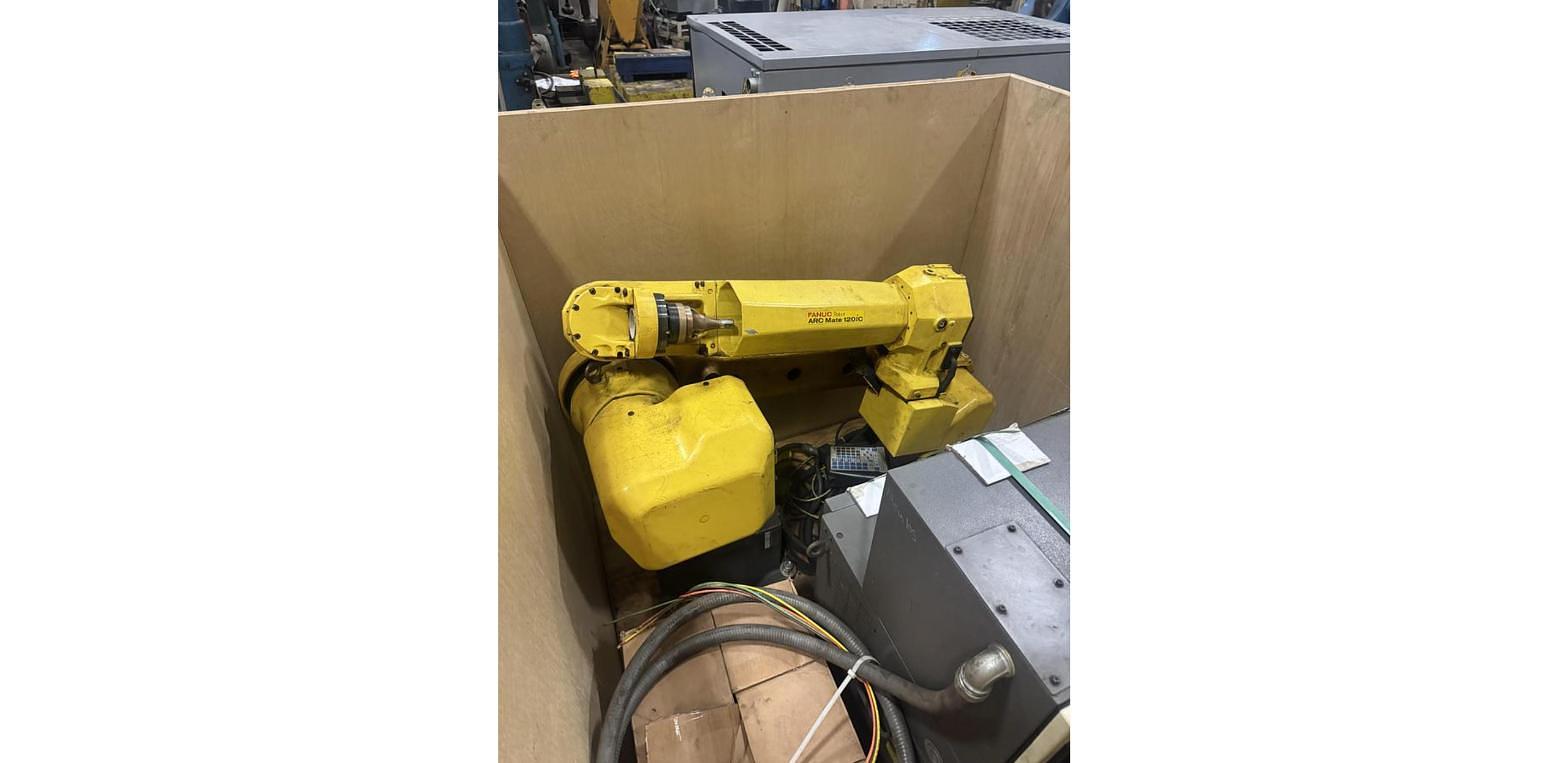
Industrial robots cut metal, stone, fiberglass and plastic with a plasma torch, a waterjet nozzle, a laser head, a router spindle or a saw. The robot carries the cutting tool along a programmed path, so picking one comes down to path accuracy, reach around the part, and whether the arm can carry the cutting head with its hoses and cables.
Why Put a Cutting Tool on a Robot
Flat sheet usually goes on a flat bed machine. Robots earn their spot on three dimensional parts: trimming formed panels, cutting holes in pipe and tube, trimming molded plastic and fiberglass parts, and cutting bevels. Six axes let the tool follow a contour and hold its angle the whole way around. Cutting is one branch of robotic material removal, alongside grinding, deburring and polishing. Most of the arms that do it are standard six axis arms with a cutting head on the wrist, and many of them are used FANUC robots.
Plasma Cutting
A plasma torch is light, so plasma work does not need a big robot. The same small and mid size arms used for welding often take the job, which is why welding arms show up in cutting cells. Our post on plasma cutting robots covers the process. If you are looking at a welding style arm for it, our FANUC Arc Mate series guide sorts out the models. Plan for the plasma power supply and fume extraction too. Those are separate from the robot.
Waterjet Cutting
Waterjet cuts cold, so there is no heat affected zone on the part. That makes it a common choice for trimming plastic parts, foam, carpet and interior trim. Read our write up on water jet cutting robots for the details. The cell is wet, and the arm lives in spray and grit all day, so check the protection rating on the data sheet for the exact model before you buy. Mid size arms like the FANUC M-710iC/50 and larger arms like the R-2000 both turn up in waterjet cells.
Laser Cutting
Robotic laser cutting is mostly three dimensional trimming of formed parts and tube. The laser head is heavier than a plasma torch and the beam delivery has to follow the arm, so path accuracy and cable routing matter more. A lot of the same hardware shows up in laser welding robots, and the same buying questions apply: payload for the head, reach for the part, and a controller that supports the path options you need.
Fiberglass and Composite Cutting
Fiberglass parts get trimmed and drilled with a router spindle or a saw on the wrist. Our post on fiberglass cutting robots covers where this gets used. The cutting force pushes back on the arm, so size the robot for more than the spindle weight alone. A stiffer, heavier arm holds the path better. Fiberglass dust is hard on seals and connectors, so cover the arm and keep the controller out of the cell.
Stone Cutting and Polishing
Stone work uses heavy saws, grinding heads and polishing pads, plus a lot of water. That pushes the job toward large arms. See our post on stone cutting and polishing robots. Large arms like the R-2000 and M-900 show up here, and our FANUC M-900 series guide covers the biggest arms we carry.
Picking a Robot for Cutting
- Tool weight and cutting force. Add the head, the mount and the hoses. For spindle work, add margin for the force pushing back. Our FANUC payload and reach quick reference helps narrow the list.
- Reach around the part. The tool has to get to every edge at the right angle, not just touch it. For long parts, a seventh axis track adds travel, and we carry FANUC robot transfer units.
- Environment. Water, dust and sparks all get into a robot. Protection ratings vary by model, so confirm them on the listing or data sheet.
- Controller. Know which generation you are buying. Our FANUC robot controllers guide walks through the generations.
- Part location. If parts are not fixtured the same way every time, robotic vision can find them before the cut.
- Tool changes. Cells that cut and then grind or drill often use robotic quick change tooling to swap heads.
Cutting Robots in Stock
These models have listings that name cutting in their applications.
- FANUC Arc Mate 100iC/6L: 6 kg payload, 1,632 mm reach
- FANUC Arc Mate 120iB: 20 kg payload, 1,667 mm reach
- Kawasaki RS010L: 10 kg payload, 1,925 mm reach, E01 controller, never used
- ABB IRB 4600-40/2.55: 40 kg payload, 2,550 mm reach
- FANUC M-710iC/50: 50 kg payload, 2,050 mm reach, R-30iB
- FANUC R-1000iA/80F: 80 kg payload, 2,230 mm reach
- FANUC R-2000iB/165F: 165 kg payload, 2,655 mm reach, R-30iA
- FANUC R-2000iB/210F: 210 kg payload, 2,655 mm reach, R-30iB controller
- FANUC M-900iA/260L: 260 kg payload, 3,100 mm reach
For more on the brands outside FANUC, see our Kawasaki RS series guide and our ABB IRB series guide.
Related Guides
Retiring a Cutting Cell?
A cutting cell that is coming out still has value in the robot and the equipment around it, and we buy both. Tell us what you have on our sell your machinery page, or ask about our machinery appraisal services. Current plant sales are on our industrial liquidations page.
For questions on a robot for your cutting job, call 586-752-0090, extension 1 for sales, or get in touch with sales.