


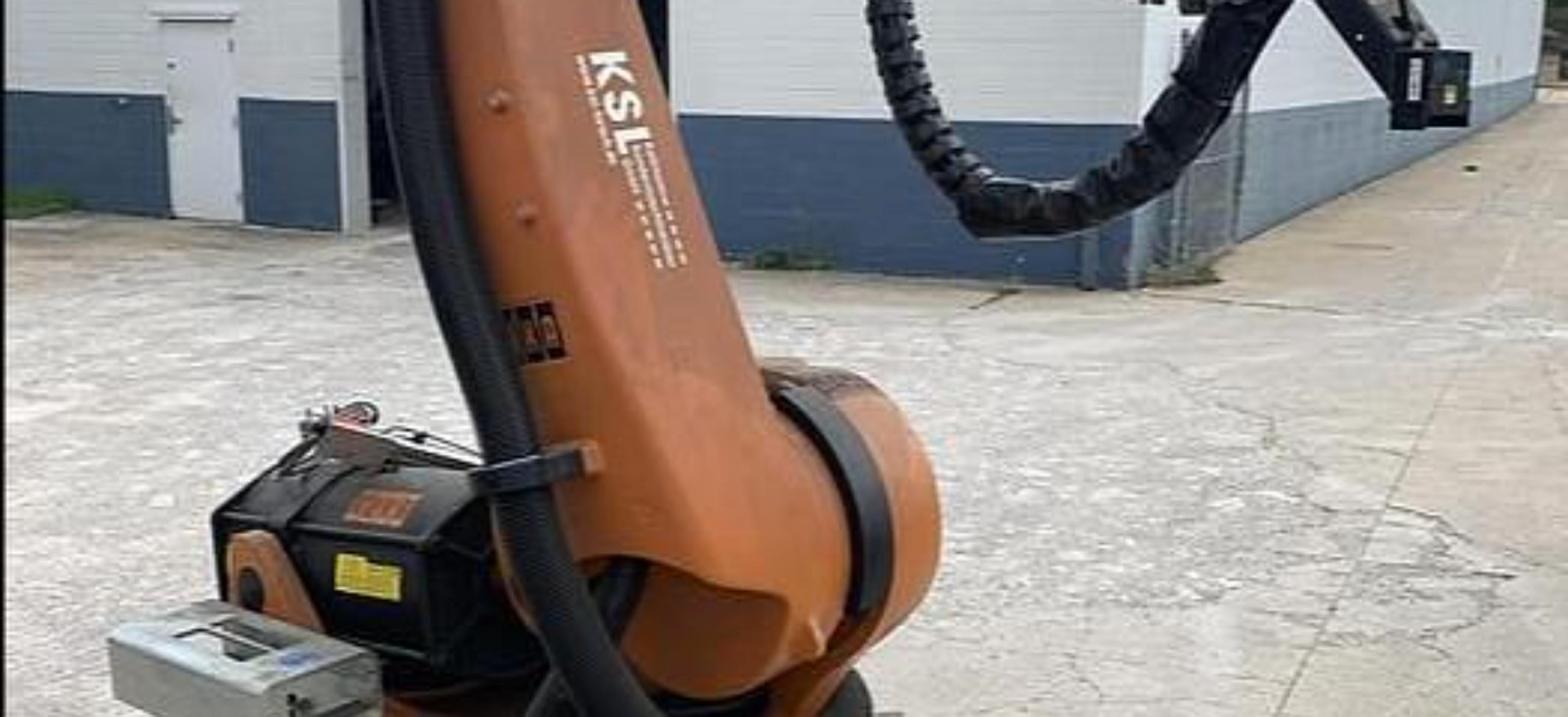
A spindle robot is an industrial arm that carries a powered spindle instead of a gripper, used for drilling, trimming, routing, sanding, polishing and deburring. Choosing one comes down to four checks: spindle and tool weight against payload, the load on the wrist, power and air to the end of the arm, and stiffness at the reach you need.
What Spindle Robots Do
Put a spindle on the wrist and the robot becomes a cutting and finishing tool. The common jobs are drilling holes in large parts, trimming and routing formed parts, sanding and polishing surfaces, and knocking burrs off castings and machined parts. Our robotic deburring guide and our post on robotic material removal cover those jobs in more detail, and our post on stone cutting and polishing robots shows how far the idea goes.
Our listings for the FANUC M-20iA name spindle robots and milling robots among its applications, and the KUKA KR 100-2 HA listing names milling. Both are on our floor in Imlay City, Michigan, along with heavier arms for bigger spindles. You can see the full range on our used FANUC robots page.
Air Spindles and Electric Spindles
Air spindles are light and simple. They need a steady supply of clean, dry air, and their speed tends to drop when the cutter loads up. Electric spindles hold speed better under load and give you more control, but they are usually heavier and need a power cable, a drive and often cooling. The weight difference matters when you are working close to the robot's rated payload.
Spindle Plus Tool Against Payload
Rated payload has to cover the spindle, the tool holder, the cutter or abrasive, the mounting bracket, any compliance unit and the hoses and cables run to the wrist. If you change tools during the cycle, add the tool changer too. Our posts on end of arm tooling and robotic quick change tooling cover those parts.
For scale, the M-20iA data sheet lists 20 kg of payload, the M-710iC/50 data sheet lists 50 kg and the R-2000iB/185L data sheet lists 185 kg. Our FANUC payload and reach chart puts the rest side by side. Leave margin. A spindle that uses up the whole rating leaves nothing for the force of the cut.
Wrist Load
Payload is only half the story. The load chart on the data sheet shows how capacity falls as the center of gravity moves out from the faceplate, and a long spindle with the cutter sticking out the end puts its weight well away from the wrist. The cut also pushes back, so the wrist sees both the static weight and the cutting force.
If your spindle is long or heavy for its weight class, look at arms built for it. Our M-20iA/35M listings note a high inertia wrist, and the M-20iA/35M data sheet lists 35 kg of payload at 1,813 mm of reach.
Air and Power to the End of the Arm
A gripper may need one air line. A spindle can need a power cable, an air supply for the motor or the tool release, coolant and signal wires to start, stop and monitor it. All of that has to run along the arm without snagging or wearing through as the wrist rotates.
- Cable routing. Our posts on robot connection cables and cable management explain what runs where.
- Signals. The EE connection on a FANUC robot carries tooling signals at the wrist. Spindle power is a separate run. Our post on industrial robot I/O covers the handshake.
- Robot cables. Make sure the cables between arm and controller are long enough for your layout. See robot cable sets, and we sell FANUC robot cable sets on their own.
Stiffness at the Reach You Need
A robot arm flexes more the farther it stretches. A spindle job that runs fine close to the base can chatter at full reach. Place the robot so the work sits in the middle of the envelope, not at the edge. A robot riser can raise the base to get a better angle on the part, and we carry Utica robot risers for R-2000 and M-900 arms. For heavy spindle work, a bigger arm working well inside its reach usually does better than a small arm at its limit.
What to Check on a Used Spindle Robot
- Total tool weight and center of gravity against the load chart, with room to spare.
- Reach and position. Measure from the base to the farthest point on the part, plus the spindle length.
- Controller. Compare generations in our FANUC robot controllers guide.
- Pendant and cables. Ask what comes with the robot before you plan the cell.
- Freight. Shipping is FOB Imlay City, Michigan, and the buyer books the truck.
Spindle Robots and Heavier Arms We Carry
- FANUC M-20iA: 20 kg payload, 1,811 mm reach, R-30iB Plus
- FANUC M-20iA/35M: 35 kg payload, 1,813 mm reach, high inertia wrist
- KUKA KR 100-2 HA: KRC2 controller, 2008
- FANUC M-710iC/50: 50 kg payload, 2,050 mm reach
- FANUC R-2000iB/185L: 185 kg payload, 3,060 mm reach
- FANUC M-900iA/350: 350 kg payload, 2,650 mm reach
- FANUC M-900iB/280, never used: 280 kg payload, 2,655 mm reach
Related Guides
Have Spindle Robots to Sell?
When a finishing cell comes out, we will look at the robots, the spindles and the rest of the line. Use our sell your machinery page, or ask for equipment appraisals if you need a value for your books. On the buying side, our robot financing page has the details.
If you have a spindle and a part in mind, call 586-752-0090, extension 1 for sales, or contact our sales team.