


Spot Weld Guns on Used Robots: Dengensha Servo Guns and What to Check
Published:
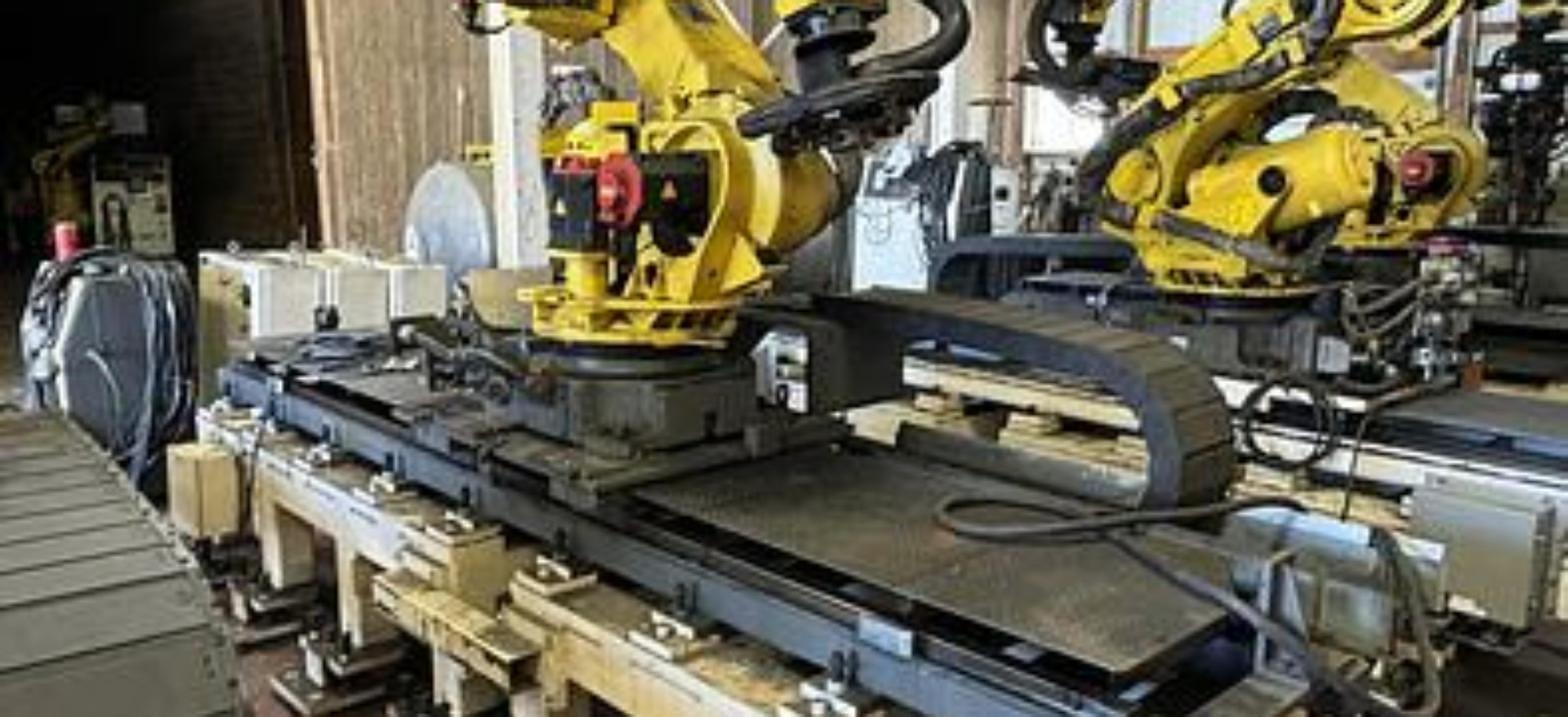
Several of our FANUC R-2000iB/165F and R-2000iC/165F spot welding robot listings include a Dengensha servo spot weld gun and power supply. Before you buy one, check that the gun style fits your joints and reaches into your part, that the tips, cables and dress pack are there, and that the gun weight sits inside the robot payload.
What Comes With These Listings
Spot welding is the job the R-2000 line was built around, and most used R-2000s spent their first life carrying a gun down an auto body line. Our post on robotic spot welding covers the process, and our write up on resistance welding robots covers the wider family of welds it belongs to.
On top of the gun and power supply, some of those listings also include a Dengensha PBM-770E program box. Not every unit carries the same package, so read the listing for the robot you are looking at, or call and ask what goes with it. If your plant already runs Dengensha equipment, that is worth asking about.
We also list a standalone Dengensha spot welder, the NDZ-050-41BNU-R-D from 2015, in our used welding equipment inventory. For anything past what the listing title shows, ask us for the nameplate details.
Servo Guns and Air Guns
A spot weld gun squeezes two copper electrodes onto the sheet and passes current through them to make the weld. What differs is how the gun closes.
- Air guns close with a pneumatic cylinder. They are simple and familiar to most maintenance crews. Force is set by air pressure, and the gun needs a steady, clean air supply at the wrist.
- Servo guns close with a servo motor. The robot controller drives the gun like an extra axis, so it can control where the tips meet, how fast they close and how hard they squeeze, and change that from one weld to the next.
Servo guns are common on newer automotive lines because the robot controls the squeeze directly. That also means the controller has to be set up for it. The gun motor needs a servo amplifier and the robot needs the matching software option. Our guide to software on a used FANUC robot explains what to ask, and we carry FANUC servo amplifiers as spares.
Both types come in two common shapes. A C gun has a fixed C shaped frame and works well on edges and flanges. An X gun, or pinch gun, opens and closes like a pair of pliers and gets around deeper flanges and into wider openings.
What to Check on a Used Spot Weld Gun
- Gun type and reach into the part. The throat depth and gun opening have to clear your flanges and get to every weld. A gun built for one body line may not reach the welds on your part. Ask for photos of the gun with its arms open.
- Tips and caps. Electrode caps wear and get dressed or replaced on a schedule. Look at the shanks and cap fit, and plan on a supply of caps that match.
- Cables and dress pack. A spot welding robot carries weld power, cooling water, air and servo cables up the arm. Check that the dress pack is complete and not worn through at the wrist. Our posts on robot connection cables and robot cable management cover what to look at, and our guide to robot cable sets covers matching robot cables.
- Weld controller and power supply. Confirm the weld control and power supply are included and match the gun. A gun without its control is not ready to weld.
- Cooling water. Guns run hot. Check the water lines and fittings on the gun and plan for water at the cell.
- Gun weight against payload. A spot gun with its transformer is heavy, and it hangs well off the faceplate. Count the gun, the mount and the dress pack against the rated payload and the wrist load chart. Our FANUC payload and reach quick reference helps you compare arms.
Matching the Robot to the Gun
The R-2000iB/165F data sheet lists 165 kg of payload with 2,655 mm of reach. The R-2000iC/165F data sheet gives the same 165 kg and 2,655 mm on a lighter arm, about 1,090 kg against roughly 1,170 kg for the iB. Our spot welding R-2000iB/165F robots run on the R-30iB controller, and so does our R-2000iC/165F stock.
If the gun is very large or the welds sit far from the base, look at a heavier arm. The M-900iA/350 data sheet lists 350 kg with 2,650 mm of reach. Our FANUC M-900 series guide covers that line. To get the gun over a tall part, a robot riser for the R-2000 and M-900 lifts the base.
If the robot has to tie into weld timers, fixtures and a PLC, read our post on industrial robot I/O and our guide to FANUC robot controllers. Shipping is FOB Imlay City, Michigan, and the buyer arranges freight.
Spot Welding Robots and Equipment We Carry
- FANUC R-2000iB/165F spot welding robots: 165 kg payload, 2,655 mm reach, R-30iB, 2014
- FANUC R-2000iB/165F spot welding robot cell: 165 kg payload, 2,655 mm reach, R-30iB, 2014
- FANUC R-2000iC/165F: 165 kg payload, 2,655 mm reach, R-30iB, 2016
- FANUC M-900iA/350: 350 kg payload, 2,650 mm reach, R-30iB
- Dengensha spot welder: NDZ-050-41BNU-R-D, 2015
More arms are on our used FANUC robots page.
Related Guides
Shutting Down a Weld Line?
We buy spot welding robots, guns and controls, from a single cell to a full body shop. Send us the details through our sell your welding equipment page, or ask about equipment appraisals first. If you are buying, see our financing page.
To ask what gun and controls go with a unit, call 586-752-0090, extension 1 for sales, or contact our sales team.