


A six axis robot can mill aluminum, plastics, foam, wood and composites, and it does its best work trimming large or complex parts. It cannot match a CNC mill on heavy cuts or tight tolerances in steel, because the arm flexes under cutting load. Use a robot for light cuts on big parts and a machining center for the rest.
What a Milling Robot Is
A milling robot is a standard industrial arm with a spindle on the wrist where a gripper would normally go. The robot moves the cutter along the path and the spindle turns it. Our post on robotic material removal covers the wider family of jobs this falls into: milling, trimming, grinding and sanding.
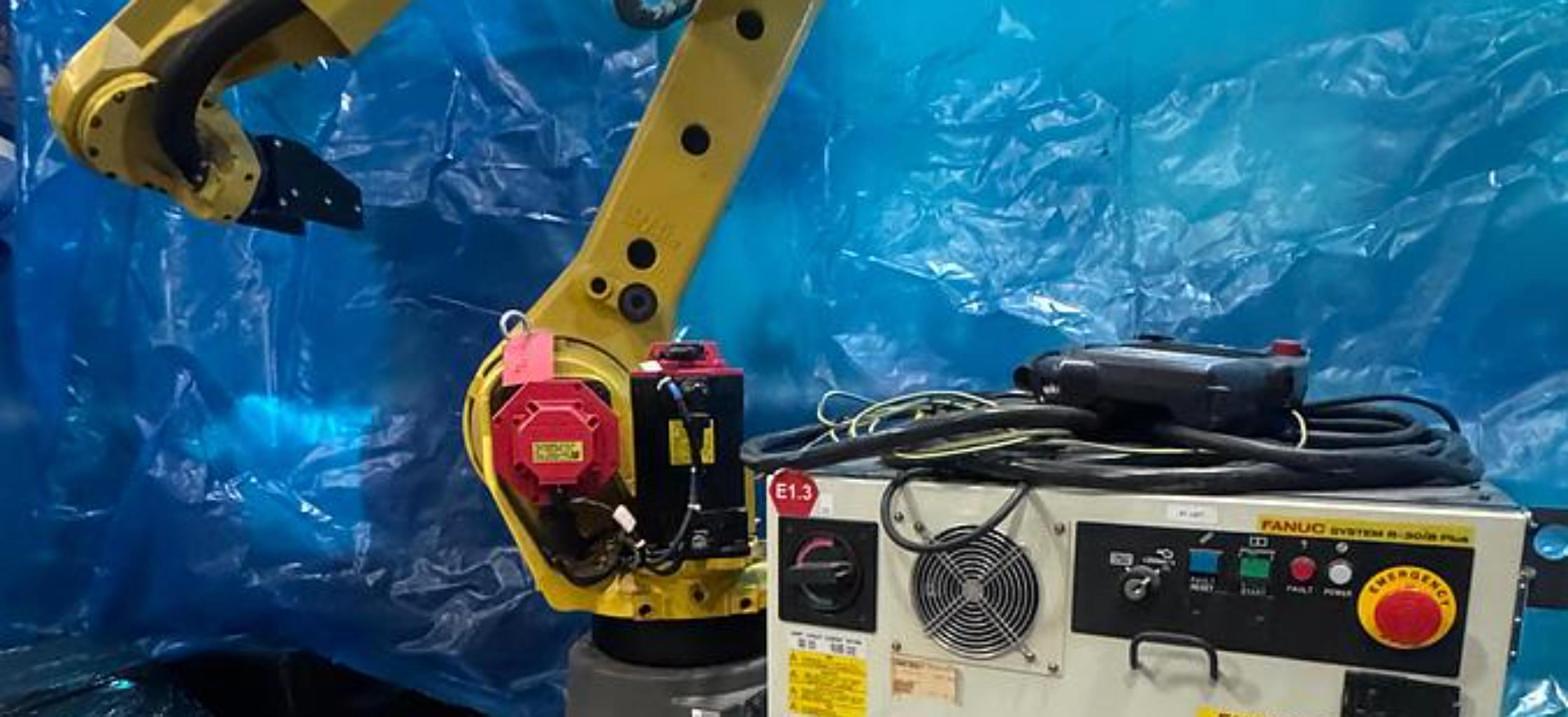
Most arms used this way are mid to heavy payload six axis robots like the used FANUC robots and used KUKA robots on our floor in Imlay City, Michigan. Our listings for the FANUC M-20iA name milling robots and spindle robots among its applications, and the KUKA KR 100-2 HA listing names milling as well.
Why an Arm Is Not a Mill
A CNC mill is a heavy casting with linear ways and ballscrews, built to stay put while the cutter pushes on the part. A robot is a chain of six joints, each with a motor, a reducer and a little give. Load the cutter and the arm deflects. The farther the wrist is from the base, the more it moves. That is the main limit on robot milling.
Repeatability on a data sheet is not the same as accuracy under load. The M-710iC/50 data sheet lists 0.07 mm repeatability. That tells you how closely the arm returns to a taught point with no force on it. Once a cutter is loaded up, the path will wander more than that, so plan on it.
If the job is steel, deep pockets or close tolerance bores, buy a machine tool. Our guide to buying a used vertical machining center is the better starting point for that work.
Materials and Jobs That Suit a Robot
- Aluminum. Light passes, facing, trimming and pocketing on castings and extrusions. Keep the depth of cut small and let the robot take more passes.
- Plastics and foam. Patterns, molds and prototypes. Cutting force is low and parts tend to be big, so the arm's reach pays off.
- Wood. Routing, profiling and edge trimming.
- Composites and fiberglass. Trimming edges and cutting openings in formed parts. See our post on robotic fiberglass cutting and our cutting robots guide.
- Finishing. Breaking edges and cleaning up parting lines. Our robotic deburring guide covers picking an arm for that.
The common thread is low cutting force. Soft material and small chips, and a robot can do the job. Hard material and heavy chips, and it cannot.
Where a Robot Beats a CNC Mill
Size and shape. A machining center has a fixed table and fixed travel, so a part either fits or it does not. A six axis arm can reach around a part, tilt the cutter to follow a curved surface and work on parts bigger than any table in your shop. Long arms help here. The R-2000iB/185L data sheet lists 3,060 mm of reach.
For long parts, a seventh axis track carries the robot down the length of the work, and we stock FANUC robot transfer units for that layout.
The Spindle Counts Against Payload
Rated payload has to cover everything on the faceplate: spindle, tool holder, cutter, mounting bracket and the hoses and cables run to the wrist. A spindle that eats most of the rated payload leaves nothing for cutting force. Our FANUC payload and reach chart lines up the common models, and our post on end of arm tooling covers what goes on the wrist.
The load chart matters as much as the payload number. Capacity drops as the center of gravity moves out from the faceplate, and a long spindle with the cutter hanging off the end puts the weight far from the wrist. Heavier arms have bigger joints and reducers and generally flex less under the same load. The M-900iA/350 data sheet lists 350 kg of payload at 2,650 mm of reach, which leaves plenty of room for a heavy spindle.
What to Check on a Used Robot for Milling
- Payload with the spindle. Total weight and center of gravity against the load chart, with margin left over.
- Reach to the work. Measure to the farthest point on the part and add the spindle length. The arm is least stiff near full reach, so keep the cutting in the middle of the envelope.
- Controller and software. Check the controller generation against our FANUC robot controllers guide and ask what software options on a used FANUC robot are loaded.
- Power and air to the wrist. The spindle needs its own power and often air or coolant. Read our posts on robot connection cables and cable management.
- Pendant and cables. Confirm what comes with the robot. Our teach pendant guide covers what to ask.
- Freight. The M-900iA/350 arm alone weighs about 1,720 kg. Everything ships FOB Imlay City, Michigan, and the buyer arranges freight.
Milling Robots and Heavier Arms We Carry
- FANUC M-20iA: 20 kg payload, 1,811 mm reach, R-30iB Plus
- KUKA KR 100-2 HA: KRC2 controller, 2008
- FANUC M-710iC/50: 50 kg payload, 2,050 mm reach
- FANUC R-2000iB/185L: 185 kg payload, 3,060 mm reach
- FANUC M-900iA/350: 350 kg payload, 2,650 mm reach
- FANUC M-900iB/280, never used: 280 kg payload, 2,655 mm reach, R-30iB
Related Guides
Retiring Robots From a Finishing Line?
We buy one robot or a whole plant of them. Start on our sell your used robots page, or ask about robot appraisals if you need a value first. Buying a milling robot instead? Look over our equipment financing options.
To talk through a specific arm, call 586-752-0090, extension 1 for sales, or send our sales team a message.