


Coating Robots: Painting, Spraying and Sealing With a Used Robot
Published:
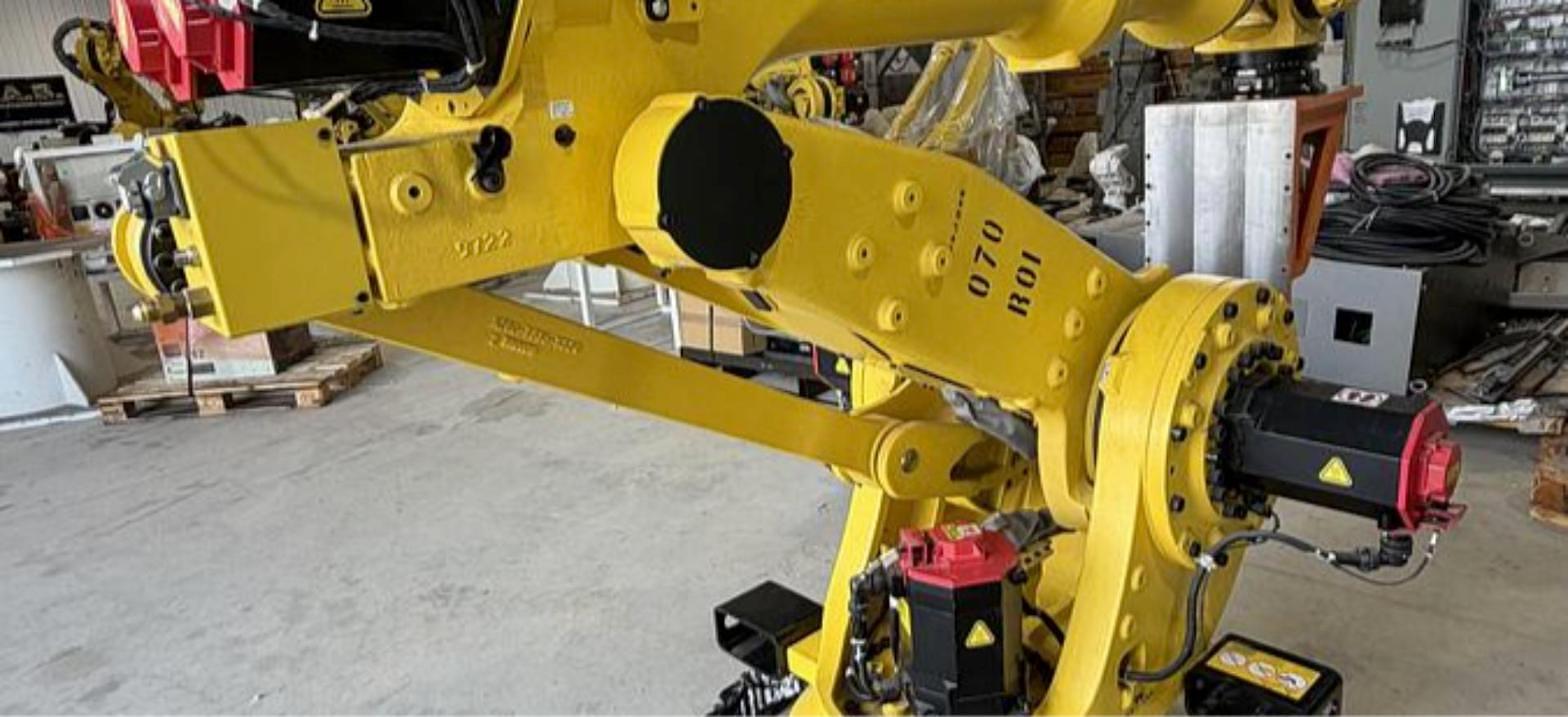
A coating robot carries a spray gun or dispensing nozzle along a set path to paint, spray or seal a part. A standard industrial arm can do much of this work outside a paint booth. In a booth with flammable solvents, the robot must be built and rated for hazardous locations. Confirm that rating on the data sheet.
Booths With Flammable Solvents Need a Rated Robot
This is the first thing to settle, before payload or reach. Solvent based paint and many spray coatings put flammable vapor in the air. A spray booth with that vapor is a hazardous location, and any robot that works inside it has to be built and rated for that environment. Robot makers build separate paint robot lines for this, with motors and wiring designed so the arm will not ignite the vapor around it. They are a different class of robot from a standard handling or welding arm.
A standard arm is not one of those just because it has a spray gun on it. Do not assume any robot in this article, or any robot you are offered, is rated for a booth. Read the data sheet and the nameplate and confirm the hazardous location rating before it goes anywhere near solvent vapor. Your fire code official and insurance carrier will want to see the same thing.
That still leaves plenty of coating work for a standard arm: water based coatings, sealers and adhesives, release agents, and spraying in open areas where there is no flammable vapor. That is where a used general purpose robot fits.
Sealing and Dispensing
Sealing is one of the most common coating jobs for a standard arm. The robot runs a bead of sealer, adhesive or urethane along a seam or flange at a steady speed so the bead comes out even. Our posts on dispensing robot applications and adhesive application with industrial robots cover how those cells work.
The dispenser matters as much as the arm. It meters the material and keeps flow steady as the robot speeds up and slows down through corners. We carry Sealant Equipment and Engineering servo dispensers for FANUC cells, listed below. The robot also has to tell the dispenser when to start and stop, so read our post on industrial robot I/O before you plan the signals.
Spraying Large Parts
A spray gun is light, so payload is rarely what limits a coating robot. Reach is. A long reach arm can cover a large part from one spot without walking the robot along it. That is why heavy, long arm robots show up on coating jobs for big parts like frames, panels and tanks.
The FANUC M-900iB/280L is a good example. Per the M-900iB/280L data sheet it carries 280 kg with 3,103 mm of reach. Our listings for the M-900iB/280L name coating among its applications. We have one never used on an R-30iB controller and one used on R-30iB Plus. Our FANUC M-900 series guide covers the rest of the line.
Our never used Kawasaki robots include BX200L, BX300L, RS080N and RS010N listings. From the data sheets:
- The Kawasaki BX200L carries 200 kg with 2,597 mm of reach.
- The Kawasaki BX300L carries 300 kg with 2,812 mm of reach.
- The Kawasaki RS080N carries 80 kg with 2,100 mm of reach.
- The Kawasaki RS010N carries 10 kg with 1,450 mm of reach, a better size for small parts.
Our Kawasaki BX, ZX, MX and CP series guide and Kawasaki RS series guide go through both families. For a part longer than any arm can cover, a seventh axis track carries the robot along it.
Path Accuracy and the Wrist
Coating quality comes from a steady path and steady speed more than from raw payload. The gun has to hold its distance and angle to the surface or the film comes out thin in one spot and runs in another. The KUKA KR 100-2 HA on KRC2 is one of the arms on our floor whose listing names coating among its applications. Our KUKA KR series guide covers the KR100 family.
Hoses for paint, air and sealer have to run up the arm and through the wrist without kinking or rubbing as the wrist turns. Our post on robot cable management covers dress out, and our write up on end of arm tooling covers gun and nozzle mounts.
What to Check Before You Buy
- Hazardous location rating. If the robot will work in a booth with flammable solvents, confirm the rating on the data sheet first. If it is not rated, it does not go in the booth.
- Reach to every surface. Map the whole part, including the far side and inside corners, and check the arm can hold the gun angle at each one.
- Overspray and cleanup. Coating material builds up on the arm. Plan covers and a cleaning routine so it does not get into joints and seals.
- Cables and pendant. Confirm the teach pendant and cables come with the robot. See our guide to robot cable sets.
- Freight. The M-900iB/280L arm alone weighs about 1,600 kg per its data sheet. Everything ships FOB Imlay City, Michigan, and the buyer arranges freight.
Coating and Sealing Robots We Carry
- FANUC M-900iB/280L, never used: 280 kg payload, 3,103 mm reach, R-30iB
- FANUC M-900iB/280L, used: 280 kg payload, 3,103 mm reach, R-30iB Plus, 2019
- Never used Kawasaki robots: BX200L, BX300L, RS080N and RS010N listings
- KUKA KR 100-2 HA: KRC2 controller, 2008
- FANUC servo dispensers: Sealant Equipment and Engineering dispensers
Related Guides
- Used Kawasaki robots buyer's guide
- FANUC payload and reach quick reference
- Used KUKA robots buyer's guide
Have Coating Robots Sitting Idle?
If a sealing line or coating cell has shut down, we buy the robots and the equipment around them. Tell us what you have on our sell your used machinery page, or ask about machinery appraisals. If you are adding a cell, look at our robot financing options.
For a data sheet or a question on a unit, call 586-752-0090, extension 1 for sales, or contact our sales team.